This article contains affiliate links. If you buy through them, I may earn a commission at no extra cost to you. As an Amazon Associate I earn from qualifying purchases.
Two machines come up in almost every beginner thread: the DeLonghi Dedica and the Gaggia Classic. Most of the advice you get about them is useless. Not because people lie, but because they answer before they know your question.
I have both machines at home and I use both. So I won’t crown a winner. Instead, here are five matchups, each with one point for the Dedica and one for the Gaggia. By the end you’ll know which one belongs in your kitchen, and you’ll probably have avoided an expensive mistake.
The two machines
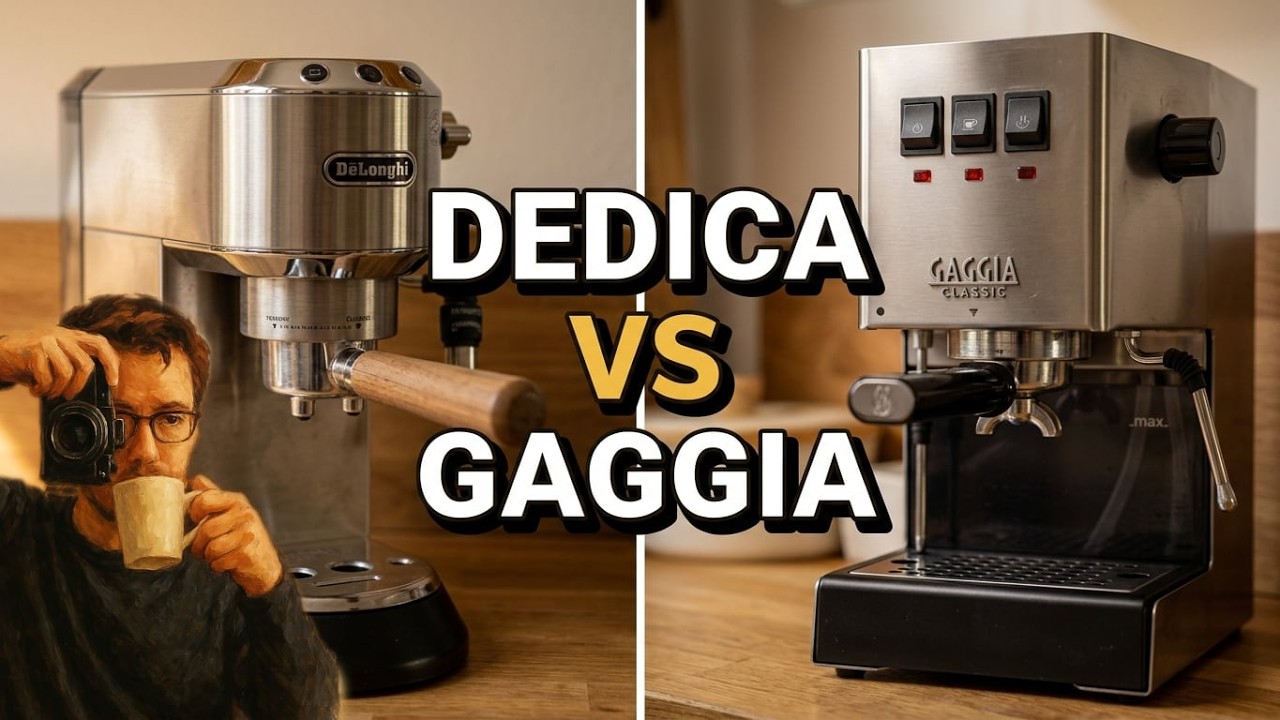
- DeLonghi Dedica EC685: a slim thermoblock machine with a 51 mm portafilter, pressurized baskets, and a panarello steam wand.
- Gaggia Classic: a single-boiler machine with a 58 mm portafilter, standard baskets, a three-way valve, and a proper steam wand.
Depending on deals, both sit somewhere between €150 and €500, and both can make really good espresso. This isn’t good versus bad.
1. Budget vs. learning curve
Dedica: the low price leaves money for the grinder. This is the most important sentence in the whole comparison: your grinder decides whether your espresso tastes good, not the machine. With €600 in total, putting €500 into the machine leaves you with a €100 blade grinder, and then both machines only make thin, bitter coffee. The Dedica gives you room: around €250 for the machine and €350 for a decent hand grinder like the Kingrinder K6 or a used electric one. That split works. The other way around doesn’t.
Gaggia: it doesn’t forgive you, and that’s the point. The Gaggia comes with a standard, single-wall basket. If your grind is wrong, the shot runs through in 8 seconds or doesn’t come out at all. You see your mistake immediately. The Dedica ships with pressurized baskets, which are basically a trick: they create the resistance your coffee grounds should provide. Something with crema always comes out, even when you get everything wrong. Comfortable, but you learn nothing. On the Gaggia you learn espresso. On the Dedica you make coffee.
You can put a non-pressurized basket like the IMS 51 mm precision basket into the Dedica. It makes the machine noticeably better. But be honest: will you actually do that, or stay with the comfortable option?
2. Heat-up time vs. steam wand
Dedica: 15 cm wide and hot in 45 seconds. That sounds like a spec sheet detail, but it decides whether you use the machine at all. If you roll out of bed at 7 and have to leave in 10 minutes, a machine that needs 20 minutes to heat up isn’t a hobby anymore, it’s an appointment. The Gaggia wants that time: not the 5 minutes until the light goes out, but the 20 minutes until group and portafilter are really at temperature. Skip it and your espresso tastes sour and thin, and you blame the machine for your own impatience.
Gaggia: the steam wand. This isn’t a nuance, it’s two different things. The Dedica’s panarello is a plastic sleeve that sucks in air and makes big, bubbly foam that collapses within 20 seconds. Fine for a cappuccino you drink right away. Not enough for latte art, ever. The Gaggia has a real steam wand, and with it you get glossy, wet microfoam that looks like melted vanilla ice cream and blends into the espresso instead of floating on top. If milk drinks are your main reason to buy, this point is probably your whole decision. You can take the sleeve off the Dedica or modify it, but on the Gaggia it works out of the box.
3. Finished product vs. upgrade path
Dedica: it’s done. That’s a real buying argument, not a dig. You unpack it, set it down, and use it. No community telling you to swap a part, no forum thread making you feel guilty. Some people want a tool, not a project. If that’s you, a moddable machine isn’t an opportunity but a source of stress that costs you €100 a month.
Gaggia: it’s not done, and that’s why it has been around for over 30 years. You can get every spare part: gaskets, shower screens, pumps, thermostats, ordered in five minutes. A Gaggia rarely breaks for good, it gets repaired. And there is the upgrade path: add a PID, or go further with the Gaggimate for temperature control, profiles, and pre-infusion. I did that, and you can read how it changed the machine in my Gaggimate review after six months. In this comparison I’m deliberately judging the stock machine, but the door is open. On the Dedica it isn’t.
4. Size and resale vs. 58 mm
Dedica: quieter, smaller, and unobtrusive in a normal kitchen. Its resale value is also surprisingly stable. If you find out after a year that the hobby isn’t for you, you lose maybe €70. That’s the cheapest way to find out whether you enjoy this at all.
Gaggia: 58 mm. That’s the professional standard size, and it opens up a whole ecosystem: bottomless portafilters that let you see channeling instead of just tasting it, precision baskets, tampers, distributors, puck screens. The Dedica locks you into 51 mm, where the choice is much thinner and often worse made. The three-way valve also makes the Gaggia the more serious espresso machine: it releases leftover pressure into the drip tray when the shot ends. On the Dedica the pressure stays in the puck, and you get wetter pucks.
5. Time vs. staying power
Dedica: it costs you less time. Sounds trivial, but most people underestimate it. In your first weeks on the Gaggia you’ll pour coffee down the drain, more than once. You’ll temperature surf, hunt for the right grind, and swear. That’s normal, and for many of us it’s exactly the fun part. But if you just want a good milk coffee in the morning, that learning curve isn’t a feature, it’s an imposition.
Gaggia: it’s rarely the machine you sell again. For many people the Dedica is a stepping stone. After about 12 months you want a bottomless portafilter, latte art, temperature control, and you buy again. The Gaggia grows with you for longer. Some people still use the same one after ten years and are simply happy.
Four questions that decide it
- How much budget is left for the grinder? If it’s less than a third, or better half, of your total budget, take the cheaper machine.
- Do you mostly drink milk drinks and want latte art? Then lean towards the Gaggia. The Dedica can do it, but the Gaggia is more fun.
- Do you want a hobby or an appliance? If the thought of changing gaskets annoys you, the answer is clear: take the Dedica.
- How many bad coffees can you take before you get frustrated? The most honest question of the four.
Answer these for yourself and you don’t need a ranking anymore. The best machine is the one that fits your morning and that you chose yourself, not the one some guy on the internet called better. If you want a second opinion that includes the grinder, the Setup Finder suggests a matching machine and grinder in about a minute.
Upgrades once you’ve decided
- Dedica: a non-pressurized basket like the IMS 51 mm basket is the single best upgrade. A Normcore 51 mm bottomless portafilter shows you what’s happening in the puck.
- Gaggia: a bottomless portafilter for the Gaggia Classic and a Motta milk pitcher for the steam wand. If the bottomless portafilter sprays, here are 10 common causes and how to fix them.
- Both: a coffee scale, so you can weigh dose and yield and actually know what you changed.