This article contains affiliate links. If you buy through them, I may earn a commission at no extra cost to you. As an Amazon Associate I earn from qualifying purchases.
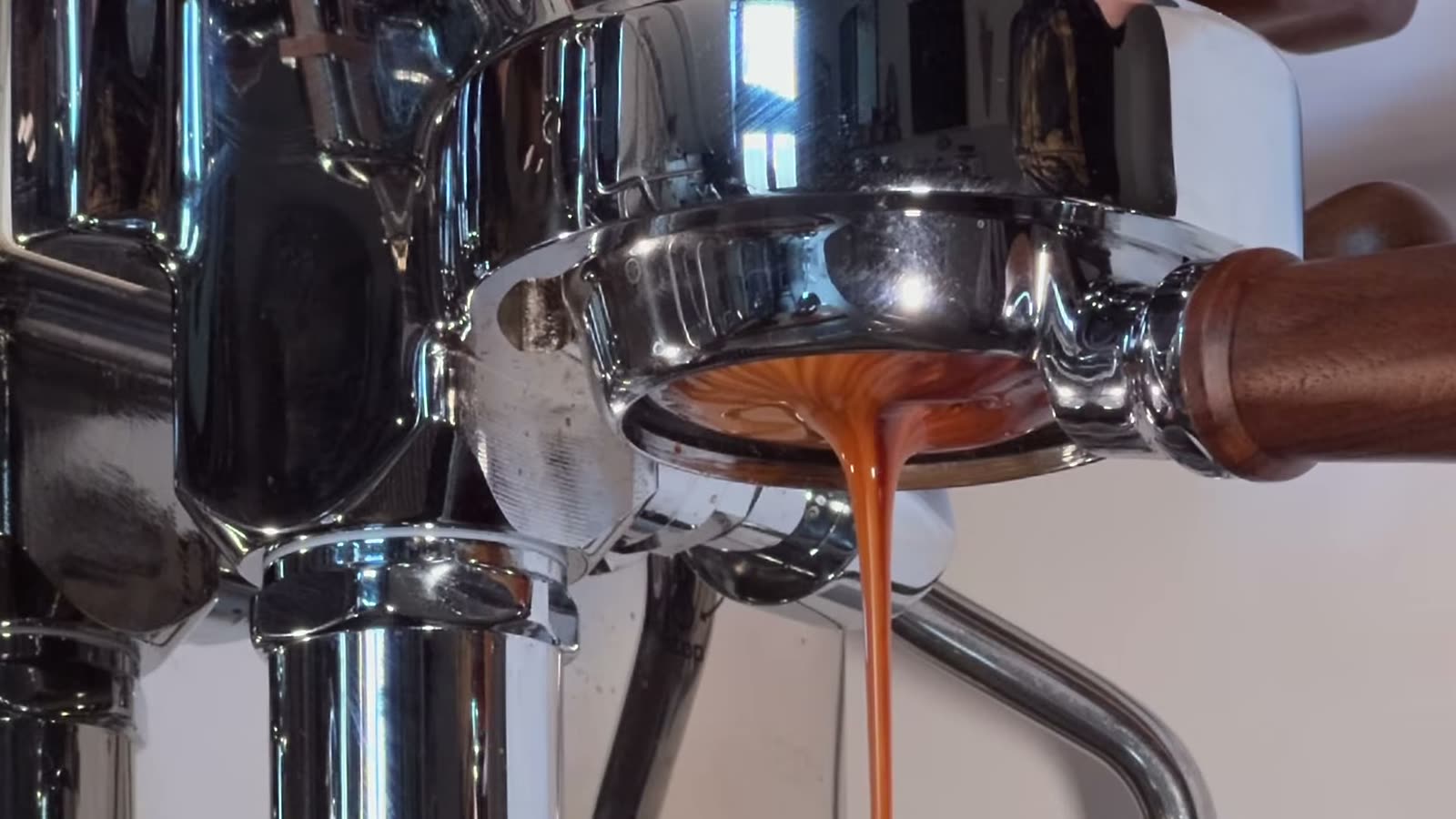
A bottomless portafilter (also called a naked portafilter) shows you the whole extraction. That is exactly why it is useful: when it sprays, it is telling you something is wrong. Channeling, uneven extraction, or one of a handful of other mistakes.
Every spray is an invitation to fix your technique. Here are the ten most common causes and how to fix each one. If you still get spray at the end, you probably skipped one of them.
1. Uneven distribution and channeling
Channeling is the main cause of spraying. Water finds paths through the puck instead of flowing evenly through all of it. Parts of the puck over-extract and taste bitter, other parts under-extract and taste sour, and on top of that it sprays. Channeling is rarely the root problem. It is a symptom of puck prep.
Fix:
- WDT: break up clumps with fine needles and stir the grounds evenly. A WDT tool is the most effective single upgrade here.
- Dosing funnel: stops grounds from spilling and helps you fill evenly. I use a dosing funnel with puck screen.
- Distributor: level the bed with light pressure before tamping, for example with a Motta 58 mm leveler.
- Tap gently: a light tap settles the grounds. Tap too hard and you open new channels.
Not sure which of these tools you actually need? I broke that down in Tamper, Leveler, and WDT: What You Actually Need.
2. Wrong grind size
Grind size is the pivot for a balanced extraction. Too coarse and water runs through like gravel: watery, sour espresso and plenty of spray. Too fine and water backs up, pressure builds, and the shot runs slow, bitter, and often erratic.
Fix:
- Watch the time. Under 25 seconds and thin? Grind finer. Over 30 seconds and bitter? Grind coarser.
- Adjust daily. Beans age. About three weeks after roasting they usually need a finer grind.
- Small steps. Move about half a step at a time and purge a little so the new setting is actually in the basket.
- Use a good grinder. Cheap grinders produce inconsistent grinds and clumps.
3. Uneven or inconsistent tamping
A tilted or unevenly tamped bed creates density differences. Water takes the path of least resistance, channels, and sprays.
Fix:
- Hold the tamper like a door knob, keep your wrist straight, elbow above the portafilter, and press straight down.
- About 13 to 14 kg is a common guideline, but consistency matters more than force.
- A calibrated, click-feedback tamper removes the guesswork. A self-leveling tamper also guarantees a level puck.
- Check the puck after tamping: level surface, no gaps at the edge.
4. Wrong dose and headspace
Too little coffee leaves too much headspace between puck and shower screen. Water pools there, finds weak spots, and sprays. Too much coffee and the puck touches the shower screen as it swells, blocking water distribution, which also causes spray.
Fix:
- Weigh every dose with a coffee scale. Typical doubles are 18 to 21 g on a machine like the Lelit Bianca and more like 15 to 17 g on small machines like the DeLonghi Dedica.
- There should always be a small gap between puck and shower screen after tamping. If you see a shower screen imprint on the puck after the shot, your dose is too high.
5. Beans that are too old or too fresh
Old beans have too little CO₂ left, so water rushes through the puck. That gives weak, watery espresso and spray. Very fresh beans are not the answer either: in the first seven days after roasting they release so much CO₂ that the turbulence destabilizes the puck and encourages channeling.
Fix: use beans roughly 14 to 30 days after the roast date. The exact window depends on the roast. Store them airtight, cool, and dark to slow down degassing and keep the aroma.
6. Pump pressure that is too high
Many entry-level machines push up to 15 bar instead of the ideal 9 bar. Even a perfect puck gets overwhelmed, water finds the smallest weak spots, and it sprays.
Fix:
- Adjust or replace the OPV. Technical, but the most effective fix. On some machines it is one screw, on others a spring swap, to bring pressure down to 9 bar.
- Use pre-infusion if your machine has it.
- Dimmer mod: advanced users can control pump pressure manually. A Gaggimate on the Gaggia Classic goes further and gives you full pressure profiling.
7. Dirty portafilter, basket, or shower screen
Coffee oils and fines slowly clog the basket holes and the shower screen. Water flows unevenly, the puck is not saturated evenly, and channeling and spray are the result. The espresso tastes bitter too.
Fix:
- Rinse portafilter and basket with hot water after every shot and wipe them dry.
- Backflush with a blind basket at the end of the day.
- Once a week, soak portafilter and basket in espresso cleaner and warm water for an hour.
- Clean the shower screen and group regularly and descale when needed.
8. Unstable or wrong water temperature
Too hot and CO₂ releases faster, bubbles form, and the puck destabilizes: channeling, spray, bitterness. Too cold and there is not enough energy for a clean extraction, so the shot under-extracts.
Fix:
- Without a PID, temperature surf: wait for the right moment in the heating cycle.
- Run a short flush before the shot to release overheated water and bring the group up to temperature.
- With a PID, lower the brew temperature slightly if you notice channeling or burnt flavors.
- Keep the portafilter in the group before grinding so it does not cool the puck.
9. Missing or too short pre-infusion
Pre-infusion wets the puck at low pressure, pushes out air pockets, and prepares the grounds for full pressure. Without it, you get a pressure shock: trapped air, instant channels, spray.
Fix:
- On machines without automatic pre-infusion, briefly pulse or hold the brew button to wet the puck at low pressure for one to two seconds.
- With a bottomless portafilter you can watch the puck saturate. Only go to full pressure once it is evenly wet.
- Often one second is enough to push the air out. Experiment with different lengths.
10. Low-quality or wrong basket
Cheap baskets often have uneven holes, in size and spacing. Water flows unevenly and sprays. Basket size and dose also have to match: a large basket with little coffee means too much headspace, a small basket with too much coffee presses the puck into the shower screen.
Fix: invest in a precision basket from VST or IMS. I use the IMS 58 mm basket. Match the basket to your dose and keep it clean as described in mistake 7.
Two extra tools that help
- Puck screen: placed on top of the tamped puck, it spreads water more evenly, softens the initial pressure, and keeps your shower screen cleaner. I use a Normcore 58.5 mm puck screen.
- Paper filter: a 58 mm paper filter at the bottom of the basket helps control spray and can improve extraction.
Change one thing at a time
Espresso reacts strongly to every variable. Change only one thing per shot and judge the effect by taste, flow, and how the shot looks. Work through distribution, grind size, tamping, dose, bean freshness, pressure, cleanliness, temperature, pre-infusion, and basket quality, and the spray will go away.
If you still need a bottomless portafilter, these are the ones I use for an E61 group and the Gaggia Classic.