This article contains affiliate links. If you buy through them, I may earn a commission at no extra cost to you. As an Amazon Associate I earn from qualifying purchases.
I made a big mistake for months, and everyone on the internet had already told me about it. I just didn’t want to hear it.
My thinking was simple. The Lelit Bianca has precise temperature control, so why would I need an extra measuring device? I can experiment without it. I was wrong, and the fix cost about €30.
Quick answer
The temperature you set on the machine is not the temperature that reaches your coffee. With a cheap thermometer and an old portafilter you can measure the gap yourself. On very light roasts, I now need to set the Bianca to around 101 °C to get the sweetness I want.
How I noticed
I used to think the discussions about brew temperature were overblown. But with light specialty roasts, the extraction kept not going the way it should. The espresso was sometimes thin, sometimes too sour.
Then I read reviews saying the offset on the machine can be set so far off that the real temperature differs from the display by 10 degrees. That’s when I stopped arguing and ordered a thermometer.
The measuring kit
There’s nothing crazy about it:
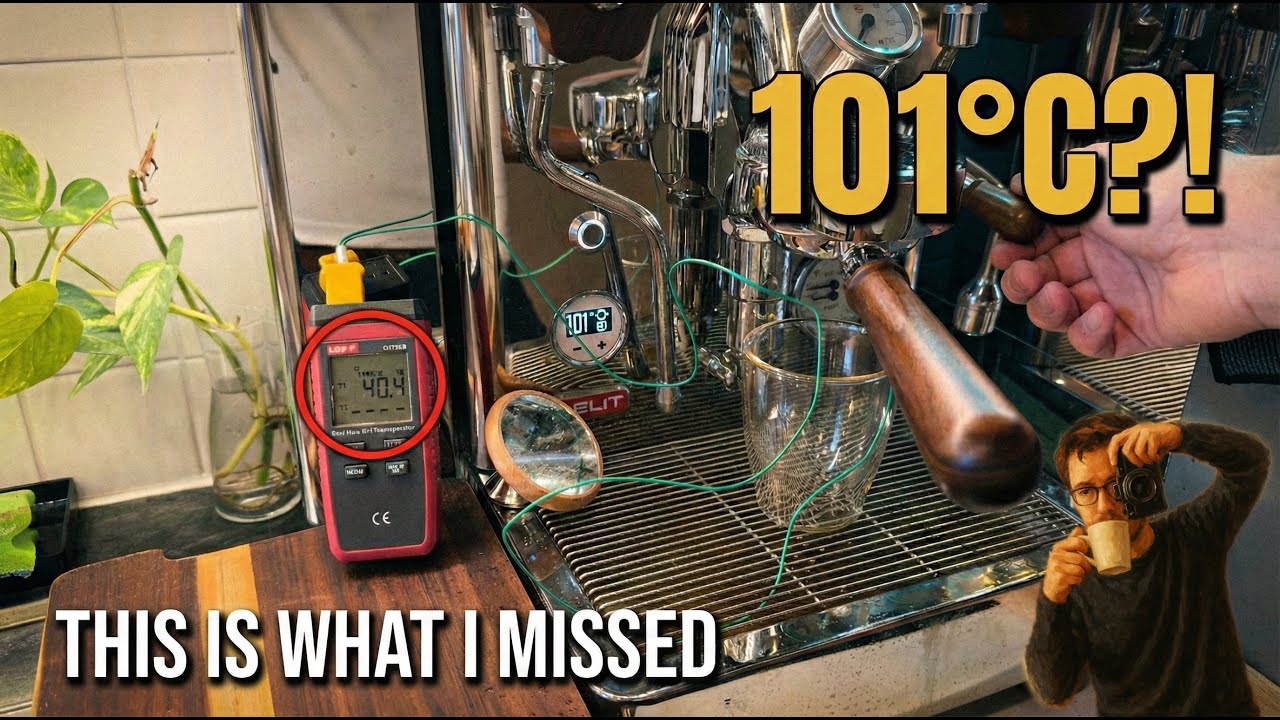
- A digital thermometer with a probe, like the one I bought, for about €30.
- An old single portafilter I hardly use. I didn’t want to sacrifice my good double.
- A drill. I carefully drilled a hole in the bottom of the basket and pushed the probe through it.
To check the thermometer, I used boiling water. Where I live, water boils at 99.3 °C, because boiling point depends on altitude. By that measure, the thermometer is accurate enough.
Measure with real coffee
I could have tested with water alone, but water doesn’t tell you the whole story. Grind size, resistance, and flow rate all affect the temperature. So I took an old pack of beans that had been out of date for months and didn’t taste great anyway, and I simulated real shots with real grounds.
What I found
I tested settings from 95 to 103 °C and measured what really arrived in the portafilter. You always lose some heat through the portafilter, the basket, and the contact with the coffee.
With light roasts the difference mattered most. On some very light third wave roasts I have to set the machine to 101 °C before the espresso develops the sweet fruitiness I want. Before that, I kept thinking I was grinding too coarse or my puck prep was off. It was simply the temperature.
- Too low, and the espresso stays sour and underextracted.
- Too high, and you pull out bitter notes you don’t want.
- A medium roast may only need about 98 °C.
- A light Ethiopian can easily go to 102 °C.
These are my settings for my machine and my beans, so treat them as a starting point. The point of the kit is that you can check your own.
My take
Measuring temperature isn’t a nice-to-have. You don’t need expensive gear for it, just €30, an old portafilter, and a drill. Afterwards you know that the number you set on the display means what you think it means.
If you want to correct the offset rather than just work around it, the setting is in the service menu. Comparing machines rather than tuning one? My Bianca vs Gaggia comparison has my daily experience with both.