This article contains affiliate links. If you buy through them, I may earn a commission at no extra cost to you. As an Amazon Associate I earn from qualifying purchases.
An electric grinder that handles espresso and filter, costs under €200, and looks good. That’s the grinder almost everyone starting with espresso is looking for. For a long time, the honest answer was that there isn’t much. In this price range you usually end up with a hand grinder, or with an electric grinder built for filter that struggles with espresso.
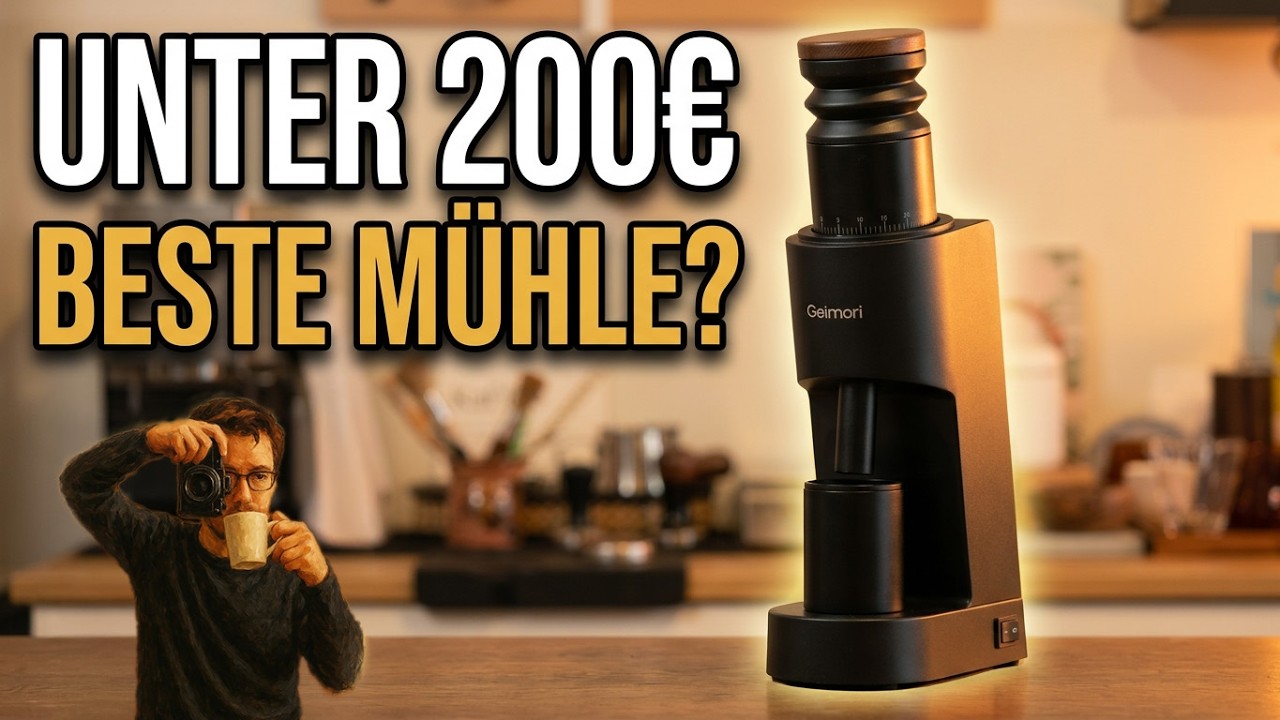
The Geimori GU38 promises exactly that. You can watch my unboxing video right above. This post sums up my first impressions. The full review comes in a few weeks, once the grinder has had enough espresso and filter behind it.
Disclosure: Geimori sent me the GU38 to test. I got the grinder for free and was not paid for the video. I decide what I say about it, and Geimori doesn’t see the video before it goes live.
What’s in the box
Besides the grinder, the box contains:
- a magnetic dosing cup
- a bellows for the bean hopper, with a nice wooden lid
- a small bottle for RDT
- a cleaning brush
The dosing cup is 54 mm wide. My portafilter on the Bianca is 58 mm. We’ll see how that works day to day.
Burrs and build
The GU38 uses 38 mm conical burrs. You usually find that size in hand grinders, not electric ones. Around them sits a full metal body. So the open question is: is this a clever compromise or a nice housing around burrs that are too small?
The first thing you notice is the weight: almost 2.5 kg at only 9 cm wide. The body is die-cast aluminium, not plastic made to look like metal. Nothing wobbles, nothing rattles, and for the price it is better built than I expected.
Grind adjustment is stepless. According to Geimori, one mark on the scale equals 20 microns. That should be fine enough to dial in espresso, at least on paper. Setup is quick: plug it in, add beans, grind.
Slow motor, by design
The motor turns at 170 rpm. That’s slow, and it’s on purpose. The idea is less heat and fewer fines, and with that more clarity in the cup. It sounds good, but I’m cautious:
- Grinding takes longer. Geimori quotes 0.6 g/s for espresso, so 18 g takes about 30 seconds. For a morning shot, I don’t mind.
- A slow motor may not have enough torque and could stall.
- Conical burrs usually stand for body and sweetness rather than clarity. Whether the low speed makes up for that is something I want to taste, not read off a spec sheet.
The hopper holds 30 g, and Geimori recommends a 90-second break after 60 seconds of grinding. You won’t grind a liter of filter coffee for guests with it. For a single V60, it’s perfect.
The hardest test first
The toughest test I can give it is a light roast as espresso on the Bianca. That’s where small burrs tend to fall behind large ones, and it’s what I’m working on for the review.
My first impression
Half of the question I can already answer: for under €200, the body is really good. The other half, the burrs, will be decided in the cup.
My first impression is very positive. If you’re not in a hurry, I’d wait for the full review. If you want it now, the code coffeexris gets you 15 percent off through the Geimori link.
What should I test for the review? Against my Eureka Mignon Single Dose? Which filter method? Let me know in the video comments. If you’re still choosing between grinders, read which espresso machine and grinder to buy or try the Setup Finder.