This article contains affiliate links. If you buy through them, I may earn a commission at no extra cost to you. As an Amazon Associate I earn from qualifying purchases.
Two boilers, a rotary pump, PID temperature control, two built-in scales and a grinder on top. All in one machine for around €1,800. That’s the Meraki Gen 2 on paper, and it sounds almost too good. The first generation had a few weak spots. The second one stood in my kitchen for about two weeks, while my Lelit Bianca stayed in the living room.
On many of those days I chose the Meraki, and every time the coffee was really good. For me personally it isn’t the right machine in the long run. It’s not a bad machine at all, though, and for a lot of people it can be exactly the right one.
Disclosure: Meraki sent me the machine. They didn’t pay me, and nobody at Meraki saw the video before it went online. We agreed on that up front. The Meraki links in this post are affiliate links. If you buy through them, I get a small commission, and the price stays the same for you.
My verdict
- Buy it if you’re moving up from an entry-level machine, drink a lot of cappuccino and like classic beans. You get a grinder, two scales, two boilers and automatic milk steaming in one machine.
- Skip it if you mostly drink light, fruity roasts or switch beans often. The built-in grinder isn’t made for that.
- Gen 1 or Gen 2: Gen 2. The bigger grind range alone is worth it.
Box and accessories
The box is nicely done. You pull out a few plastic inserts, lift the box off upwards, and the machine is presented to you. There’s more in it than I expected: a wooden tamping station with a metal tamper, a dosing cup, a distributor, a milk jug, a blind basket for cleaning, a brush for the group and a cloth I like more than I thought I would.
My favorite is the dosing cup. It sits nicely in the hand and a light magnet holds it in place. The selection isn’t quite mine, though. I wouldn’t have needed the distributor. A small knock box, or a funnel and a WDT tool, would have been more useful. And I’d rather have a brush for the portafilter than for the group. That’s complaining at a high level, and it leaves you room to buy the accessories you actually want.
Design and build
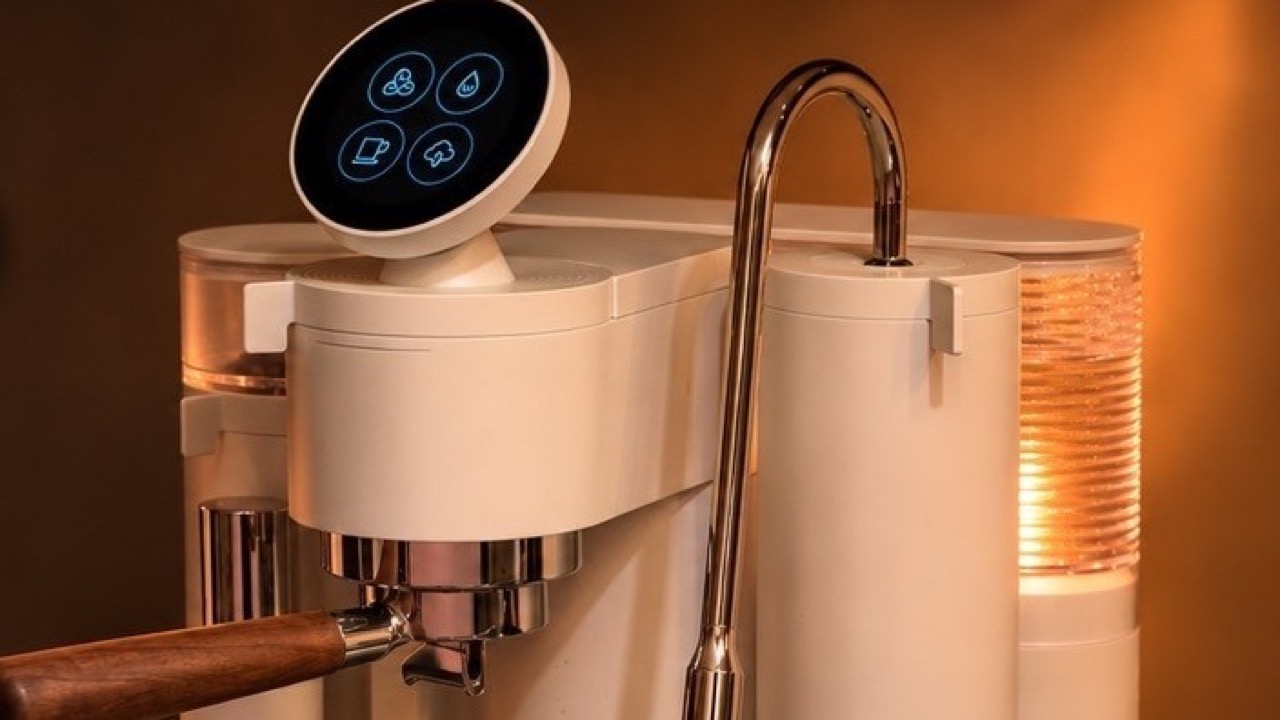
Mine is white, and it looks really good in the kitchen. I have a lamp behind the big water tank, so it glows a little, and you always see how much water is left. I especially like the metal grid on the drip tray.
The size is well chosen. Big enough to look like a serious machine, narrow enough for a normal kitchen. Quite a few parts are plastic. That doesn’t bother me, and I like the mix of materials. For €1,800 it could feel a bit more premium in one or two places. Overall the quality surprised me in a good way.
A morning with the Meraki
Switching on. This is the first thing that annoys me. The button sits on the back of the display. A short press does nothing, a longer press doesn’t either at first, and after a short pause it starts after all. I still don’t know how long I have to hold it. It does start reliably, but this could be nicer.
Heating up. When the machine thinks it’s ready, it beeps. I usually wait a bit longer until it’s properly warmed through. For me that’s 10 to 12 minutes until the first shot. If you don’t want to wait, you can let it switch on by itself on a schedule.
Grinding by weight. This is the idea I like most about the Meraki. There’s a scale under the grinder. I set 19 g, tap grind, and the grinder stops by itself. It doesn’t hit the target exactly, usually it’s off by up to 0.2 g. At 19 g that’s about 1 percent, and you won’t taste it. A grinder that grinds by time wouldn’t be more accurate.
One thing still bugs me. While the grinder runs, the machine locks everything else. I’m used to starting the grinder and rinsing and wiping the portafilter in the meantime. That doesn’t work here. I rinse first, then grind, and stand idle next to the machine for a few seconds every time. There’s also no physical button for the grinder, only the display.
The portafilter. A common complaint about the first generation was metal rubbing on metal when you lock in the portafilter. With the included portafilter you still hear and feel it. Honestly, I don’t find it as bad as some other videos made it sound, and it doesn’t bother me.
What’s new is that E61-style portafilters now fit. My Miss Silvia portafilter fits about as well as the original. The Lelit one fits best: it goes in easily, sounds less like metal and sits exactly at 12 o’clock. I almost like it more in the Meraki than in my Bianca.
I really like Meraki’s own portafilter too. The removable double spout is well made: it holds firmly enough not to slip out but still comes off easily. Thanks to the straight walls, larger baskets fit as well, like my MisChief Spirit, which wouldn’t have fit in the Lelit.
Brewing and extras
The shot itself is pleasantly quiet. You barely hear the rotary pump. The second scale sits under the portafilter. I set how much espresso should end up in the cup, say 38 g, and the machine stops by itself.
I set the brew temperature on the display, and a PID holds it. For pre-infusion I choose the time and a pressure between 3 and 4 bar. Beyond that I can’t control the pressure during the shot. More on that in the conclusion.
Behind the group there’s also a hot water outlet. With it you make an Americano right away. A really nice detail.
Then there’s Coffee Sense. You hold a bag of Meraki coffee to a sensor and the machine loads the recommended settings for that bean. I haven’t tried it, because no Meraki coffee came with my machine.
The grinder and the taste
How the espresso tastes depends mostly on the grinder. The good news first. The scale goes from 0 to 30, and on Gen 2 you can keep turning past both ends. That makes 45 steps instead of 30. That was one of the most criticized points on the first generation, and I think they found a good solution. For fine espresso I got close to the end of the range but never past it, and I had no problems at the coarse end either. For espresso the range is really enough. It can’t grind for filter, though. If you want filter coffee, you need a good hand grinder on the side.
Classic beans. With dark and medium roast espresso beans I was really happy with the taste, as espresso and as cappuccino. Over those days I let a few people taste, and some said it was the best coffee they’d ever had at my place. The Meraki brings out classic flavors well.
A very light roast. Then I pulled a very light, fruity filter roast as espresso. I like very light beans because of their complex, fruity flavors, and for a grinder it’s the hardest test. Dialing in was quick. I didn’t drink it, honestly. From the Meraki grinder it was sour, bitter and dry, all at once. The grind size was right, and with some tweaking of time and temperature you might have gotten a bit more out of it.
I ground the same bean with my Geimori GU38, also a conical grinder, but one that focuses on clarity and grinds very slowly. Clearly juicier, with a nice acidity and a little bitterness, almost vanilla and caramel, velvety in the mouth.
For light, fruity coffees the Meraki grinder just isn’t made for me, and that’s fine. Both grinders have their strengths. The Meraki grinder is fast and precise, and for classic roasts I’m happy with it.
Milk: the part that won me over
The steam wand already looks very professional. It’s long and has a joint with exactly the right resistance. The steam comes from its own boiler, has plenty of power and is nicely dry.
The best part is the automatic mode. The wand has a thermometer at the tip, and I set the milk temperature at which the steam should stop. I push the wand down, put the jug under it, and the machine steams until the milk reaches that temperature. I don’t have to do anything, and it works well. If you like cappuccino and sometimes make coffee for a few more people, that’s really great.
There’s a small catch here too. Milk burns onto the wand fairly easily. I have to wipe it with a damp cloth every time, otherwise it sticks. Don’t forget that.
Cleaning and software
Cleaning the rest of the machine is great. The blind basket is included, and there’s even a program for automatic backflushing. Nothing to complain about.
I generally like the software, and it’s nicely designed. In a few places you notice Meraki still has work to do. One example: I start the espresso on the display and steam by hand with the steam lever at the same time. Both run, and at the top I see the milk temperature. As soon as the espresso is done, the temperature disappears. I have to confirm and go back to the home screen before it shows again. And when I steam with the lever, I can’t make it stop at the target temperature. Not a big deal, but small things an update could fix.
Why it isn’t the machine for me
I like to experiment, drink a different bean almost every day and try light roasts. For that I need single dosing, a grinder with lots of clarity, pressure control and so on. The Meraki wants to be something else. It gives you a good workflow and takes decisions off your hands instead of giving you every dial.
Who should buy the Meraki
Upgrading from an entry-level machine, drinking cappuccino and liking classic beans: then the Meraki is a very good choice. You get a grinder, two scales, two boilers and automatic milk steaming in one machine, and you don’t have to think about your next grinder. I see that as a big advantage. You don’t have to research forever which machine and grinder to get or browse accessories for weeks. Almost everything you need arrives in one box. That’s also why I think it’s a very good machine if you’re just starting with espresso. It eases you into it.
Mostly light, fruity roasts or switching beans often: then I’d advise against it. The grinder isn’t good enough for that. A machine with a separate grinder that suits those beans will serve you better.
If you want both, there’s a middle way I like. Put a classic bean for every day and for cappuccino in the Meraki’s big hopper. Next to it, keep a small single dose grinder like the Geimori for light coffees, decaf and experimenting. Then you don’t have to fuss every morning and still stay flexible.
Gen 1 or Gen 2?
You get the first generation cheaper. I’d still recommend the second. The bigger grind range in particular is real progress for me and makes the machine feel more complete.
Warranty and repairs
The question you ask about every machine you order online: what if something breaks? According to Meraki, you have 30 days to try it at home and a two-year warranty. Repairs are done by authorized service partners near you, and Meraki pays the shipping for repairs. I don’t have concerns there. How that works out long term I can’t know yet, of course.
In November 2026 Meraki ran a Black Friday offer for the Meraki Gen 2: €1,699 including an 8-piece barista kit.
Conclusion
Overall the Meraki is an interesting, well thought-out machine. With classic beans and for cappuccino it won me over. With light, fruity roasts the built-in grinder hits its limit. I’ll keep testing it for a few more months and report back with a long-term review.
Do you prefer a machine with a built-in grinder or a separate machine and grinder? Tell me in the video comments, along with what you’d like me to check in the long-term test. If you’re still deciding, read which espresso machine and grinder to buy or try the Setup Finder.